MY PROFIL

Nama : Hasan Wirayuda Tempat Tanggal/Lahir : Cibitung, 14 Mei 1993 Jenis Kelamin : Laki-laki Agama : Islam Hobi : Olahraga Kewarganegaraan : Indonesia E-mail : wirayudash@gmail.com dehanforever@gmail.com

Translate

  • This is Slide 1 Title

    This is slide 1 description. Go to Edit HTML and replace these sentences with your own words. This is a Blogger template by Lasantha - PremiumBloggerTemplates.com...

  • This is Slide 2 Title

    This is slide 2 description. Go to Edit HTML and replace these sentences with your own words. This is a Blogger template by Lasantha - PremiumBloggerTemplates.com...

  • This is Slide 3 Title

    This is slide 3 description. Go to Edit HTML and replace these sentences with your own words. This is a Blogger template by Lasantha - PremiumBloggerTemplates.com...

Sunday, August 14, 2016

U.S. Democrat Pelosi gets 'obscene and sick' calls after hack

U.S. Democrat Pelosi gets 'obscene and sick' calls after hack

Saturday, August 13, 2016

Linux bug leaves USA Today, other top sites vulnerable to serious hijacking attacks

Linux bug leaves USA Today, other top sites vulnerable to serious hijacking attacks

"Off-path" attack means hackers can be anywhere with no man-in-the-middle needed.


Computer scientists have discovered a serious Internet vulnerability that allows attackers to terminate connections between virtually any two parties and, if the connections aren't encrypted, inject malicious code or content into the parties' communications.

The vulnerability resides in the design and implementation of RFC 5961, a relatively new Internet standard that's intended to prevent certain classes of hacking attacks. In fact, the protocol is designed in a way that it can easily open Internet users to so-called blind off-path attacks, in which hackers anywhere on the Internet can detect when any two parties are communicating over an active transmission control protocol connection. Attackers can go on to exploit the flaw to shut down the connection, inject malicious code or content into unencrypted data streams, and possibly degrade privacy guarantees provided by the Tor anonymity network.
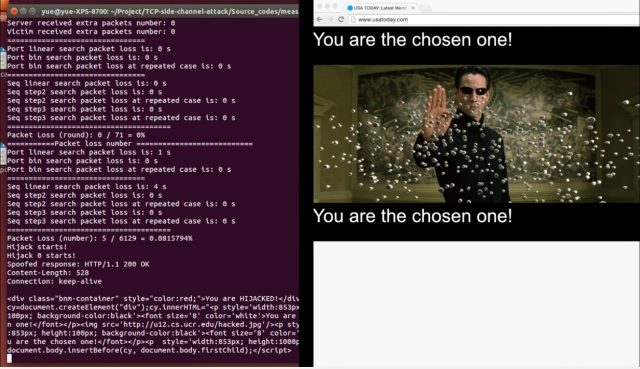
At the 25th Usenix Security Symposium on Wednesday, researchers with the University of California at Riverside and the US Army Research Laboratory will demonstrate a proof-of-concept exploit that allows them to inject content into an otherwise legitimate USA Today page that asks viewers to enter their e-mail and passwords. The malicious, off-site JavaScript code attack is possible because the vulnerable USA Today pages aren't encrypted. Even if they were protected, attackers could still terminate the connection. Similar attacks work against a variety of other unidentified sites and services, as long as they have long-lived connections that give hackers enough time—roughly 60 seconds—to carry out the attack.


Top sites remain vulnerable

The problematic RFC 5961 has not yet been fully implemented in Windows or Mac OS X, so those operating systems aren't believed to be vulnerable. By contrast, the Linux operating system kernel, starting with version 3.6 introduced in 2012, has added a largely complete set of functions implementing the standard. Linux kernel maintainers released a fix with version 4.7 almost three weeks ago, but the patch has not yet been applied to most mainstream distributions. For the attack to work, only one of the two targeted parties has to be vulnerable, meaning many of the world's top websites and other services running on Linux remain susceptible.
In an accompanying research paper titled Off-Path TCP Exploits: Global Rate Limit Considered Dangerous, the researchers said the vulnerability is the result of changes in the way TCP establishes a connection. When carrying out a so-called three-way handshake, the first of two parties sends a SYN (short for synchronize) packet, the receiving party responds with a SYN-ACK (synchronize-acknowledgement) packet, and the connection is established when the first party sends an ACK packet.
While similar attacks have existed for several years, the introduction of RFC 5961 makes this new exploit much more powerful. That's because the attacker need only have an Internet connection, even when there's no man-in-the-middle ability to control or monitor traffic passing between the two parties. The researchers wrote:
In this paper, we discover a much more powerful off-path attack that can quickly 1) test whether any two arbitrary hosts on the Internet are communicating using one or more TCP connections (and discover the port numbers associated with such connections); 2) perform TCP sequence number inference which allows the attacker to subsequently, forcibly terminate the connection or inject a malicious payload into the connection. We emphasize that the attack can be carried out by a purely off-path attacker without running malicious code on the communicating client or server. This can have serious implications on the security and privacy of the Internet at large.
The root cause of the vulnerability is the introduction of the challenge ACK responses and the global rate limit imposed on certain TCP control packets. The feature is outlined in RFC 5961, which is implemented faithfully in Linux kernel version 3.6 from late 2012. At a very high level, the vulnerability allows an attacker to create contention on a shared resource, i.e., the global rate limit counter on the target system by sending spoofed packets. The attacker can then subsequently observe the effect on the counter changes, measurable through probing packets.
Through extensive experimentation, we demonstrate that the attack is extremely effective and reliable. Given any two arbitrary hosts, it takes only 10 seconds to successfully infer whether they are communicating. If there is a connection, subsequently, it takes also only tens of seconds to infer the TCP sequence numbers used on the connection. To demonstrate the impact, we perform case studies on a wide range of applications.
Besides injecting malicious JavaScript into a USA Today page, the researchers also show how the vulnerability can be exploited to break secure shell, or SSH, connections and tamper with communications traveling over Tor. In the latter case, attackers can terminate key links in the Tor chain—for instance, those connecting an end user to an entry node, an entry node to a middle relay, or a middle relay to the exit node. The Tor attack could be particularly effective if it knocked out properly functioning exit nodes because the technique would increase the chances that connections would instead use any malicious exit nodes that may exist.
"In general, we believe that a DoS attack against Tor connections can have a devastating impact on both the availability of the service as a whole and the privacy guarantees that it can provide," the researchers wrote. "The default policy in Tor is that if a connection is down between two relay nodes, say a middle relay and an exit relay, the middle relay will pick a different exit relay to establish the next connection. If an attacker can dictate which connections are down (via reset attacks), then the attacker can potentially force the use of certain exit relays."
The researchers went on to offer a workaround solution while administrators of vulnerable systems wait for a permanent fix. While Windows, OS X, and most other operating systems aren't believed to be vulnerable, the researchers warned that they could become susceptible if developers don't use extreme care when more fully implementing RFC 5961.
"It is a subtle problem," researcher Zhiyun Qian told Ars when asked if the vulnerability resided in the RFC specification itself or a specific implementation of it. "I want to say that the RFC is written in a way that if OSes implement it straightforwardly, it is going to be problematic. So I think we should probably split the responsibility between the RFC and implementation."


New air-gap jumper covertly transmits data in hard-drive sounds

New air-gap jumper covertly transmits data in hard-drive sounds

"DiskFiltration" siphons data even when computers are disconnected from the Internet.


Researchers have devised a new way to siphon data out of an infected computer even when it has been physically disconnected from the Internet to prevent the leakage of sensitive information it stores.
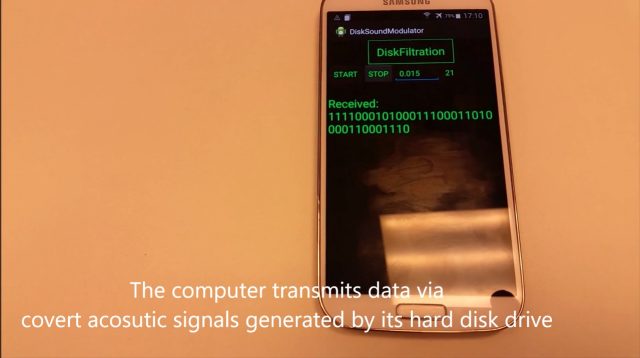
The method has been dubbed "DiskFiltration" by its creators because it uses acoustic signals emitted from the hard drive of the air-gapped computer being targeted. It works by manipulating the movements of the hard drive's actuator, which is the mechanical arm that accesses specific parts of a disk platter so heads attached to the actuator can read or write data. By using so-called seek operations that move the actuator in very specific ways, it can generate sounds that transfer passwords, cryptographic keys, and other sensitive data stored on the computer to a nearby microphone. The technique has a range of six feet and a speed of 180 bits per minute, fast enough to steal a 4,096-bit key in about 25 minutes.
"An air-gap isolation is considered to be a hermetic security measure which can prevent data leakage," Mordechai Guri, a security researcher and the head of research and development in the cyber security labs at Israel's Ben-Gurion University, told Ars. "Confidential data, personal information, financial records and other type of sensitive information is stored within isolated networks. We show that despite the degree of isolation, the data can be exfiltrated (for example, to a nearby smart phone)."
Besides working against air-gapped computers, the covert channel can also be used to steal data from Internet-connected machines whose network traffic is intensively monitored by intrusion prevention devices, data loss prevention systems, and similar security measures. The technique is documented in a technical paper titled DiskFiltration: Data Exfiltration from Speakerless Air-Gapped Computers via Covert Hard Drive Noise, which was published Thursday night. Guri and the other Ben-Gurion University researchers who devised the covert channel created the video demonstration below.


DiskFiltration is only the latest method devised by Ben-Gurion University researchers to bridge air gaps. Other techniques include AirHopper, which turns a computer's video card into an FM transmitter; BitWhisper, which relies on the exchange of heat-induced "thermal pings"; GSMem, which relies on cellular frequencies; and Fansmitter, which uses noise emitted by a computer fan to transmit data. In 2013, researchers with Germany's Fraunhofer Institute for Communication, Information Processing, and Ergonomics devised a technique that used inaudible audio signals to covertly transmit keystrokes and other sensitive data from air-gapped machines. The techniques are effective, but their utility in real-world situations is limited. That's because the computers they target still must be infected by malware. If the computers aren't connected to the Internet, the compromise is likely to be extremely difficult and would require the help of a malicious insider, who very well may have easier ways to obtain data stored on the machine. Still, the air-gap jumpers could provide a crucial means to bypass otherwise insurmountable defenses when combined with other techniques in a targeted attack.
Receiving data transmitted by sound generated from a hard drive is generally not efficient. DiskFiltration improves the signal-to-noise ratio by focusing on a narrow range of acoustic frequencies, a feature that effectively strips out background noise. DiskFiltration works even when a hard drive's automatic acoustic management, which reduces acoustic noise, is at its default setting. Still, casual noise emissions from other running processes can sometimes interfere or interrupt the DiskFiltration transmissions.
The most effective way to prevent DiskFiltration-style data exfiltration is to replace hard drives with solid-state drives, since the latter aren't mechanical and generate virtually no noise. Using particularly quiet types of hard drives or installing special types of hard drive enclosures that muffle sound can also be an effective countermeasure. It may also be possible to jam hard-drive signals by generating static noise. Intrusion prevention systems may also be programmed to detect suspicious hard-drive seek patterns used to create the transmissions. Yet another solution is to isolate air-gapped computers from smart phones and other devices with a microphone.

T-Mobile dumps the HTC 10 after just two months

T-Mobile dumps the HTC 10 after just two months

HTC can’t catch a break as carrier opts to stop selling its flagship phone.

Poor HTC. The company's flagship handset, the HTC 10, is apparently not selling well. T-Mobile has decided to dump the device after just two months on the market.
T-Mobile hasn't come out and ended sales officially, but the HTC 10 is no longer available from T-Mobile online. The phone used to live on T-Mobile's website at http://www.t-mobile.com/cell-phones/htc-10.html, but that link now redirects to a generic HTC page that only shows the HTC Desire 530. A Reddit thread notes that the HTC 10 vanished from T-Mobile's site in July, which gives it a shelf life of just two months. TmoNews says it was originally told that the 10's disappearance was "a glitch" and that the phones would be back. But as Android Police points out, the 10 is still gone, and local stores don't have any plans to receive more units.
Too bad. We called the HTC 10 the "the best Android flagship of 2016." HTC finally cleaned up the huge front bezels, and we were won over by its metal body and a software package that was close to stock Android. None of that seems to be translating into sales, though. After a 35 percent year-over-year decline in revenue for 2015, HTC is on pace for a 50 percent year-over-year decline in 2016.

Kansas couple sues IP mapping firm for turning their life into a “digital hell”

Kansas couple sues IP mapping firm for turning their life into a “digital hell”

Company fixed the error, but it may be years before the issue is resolved.


Ever since James and Theresa Arnold moved into their rented 623-acre farm in Butler County, Kansas, in March 2011, they have seen “countless” law enforcement officials and individuals turning up at their farm day and night looking for links to alleged theft and other supposed crime. All of these people are arriving because of a rounding error on a GPS location, which wrongly points people to their farm.
In their lawsuit filed against MaxMind, the IP mapping firm, the Arnolds allege:
The following events appeared to originate at the residence and brought trespassers and/or law enforcement to the plaintiffs’ home at all hours of the night and day: stolen cars, fraud related to tax returns and bitcoin, stolen credit cards, suicide calls, private investigators, stolen social media accounts, fund raising events, and numerous other events.
James Arnold has even been “reported as holding girls at the residence for the purpose of making pornographic films.”
According to the suit, which was filed last Friday in Kansas federal court, all of these accusations were and continue to be false. Earlier this year, the news site Fusion revealed to the Arnold family and to the world why so many people continuously turn up at the Butler County farm.
As Fusion’s Kashmir Hill reported:
As any geography nerd knows, the precise center of the United States is in northern Kansas, near the Nebraska border. Technically, the latitudinal and longitudinal coordinates of the center spot are 39°50′N 98°35′W. In digital maps, that number is an ugly one: 39.8333333,-98.585522. So back in 2002, when MaxMind was first choosing the default point on its digital map for the center of the U.S., it decided to clean up the measurements and go with a simpler, nearby latitude and longitude: 38°N 97°W or 38.0000,-97.0000.
As a result, for the last 14 years, every time MaxMind’s database has been queried about the location of an IP address in the United States it can’t identify, it has spit out the default location of a spot two hours away from the geographic center of the country. This happens a lot: 5,000 companies rely on MaxMind’s IP mapping information, and in all, there are now over 600 million IP addresses associated with that default coordinate. If any of those IP addresses are used by a scammer, or a computer thief, or a suicidal person contacting a help line, MaxMind’s database places them at the same spot: 38.0000,-97.0000.
And that precise GPS location is exactly where the Arnold family lives.
Randall Rathbun, the Arnolds’ lawyer, told Ars that this continues even now, months after Hill uncovered MaxMind’s error. “I think the last time the sheriff’s office was out was a month ago,” he said.
To its credit, MaxMind has since fixed the error in its IP databases by moving the location of a default IP address to the middle of a Kansas lake, but customers do not often update their data, so it could be many years before this issue is fully resolved.
David Robbins, a company spokesman, declined comment.
“Thanks for reaching out to us,” he said. “MaxMind is aware of the lawsuit but does not comment on pending litigation.”
The lawsuit seeks a judgement of at least $75,000, but Rathbun told Ars that he would likely seek more in forthcoming filings.

Friday, August 12, 2016

Newness is inherently tempting. As people adopt emerging technologies, brands have always followed suit. It's evolutionary. For as long as advertising has existed, brands have flocked towards new forms of communication in order to better present and differentiate themselves

Newness is inherently tempting. As people adopt emerging technologies, brands have always followed suit. It's evolutionary. For as long as advertising has existed, brands have flocked towards new forms of communication in order to better present and differentiate themselves.

However, the success of this strategy is often dependent on whether the brand uses these technologies to provide something of value to its audience. Novelty alone does not justify adoption. So the delivery of convenience, entertainment, knowledge or monetary value must be acknowledged at all times.
While some brands have embraced technology to provide value with proficiency, many have failed. Unfortunately, with today's landscape and tomorrow's forecast, the opportunities for brands to adopt new technologies will only increase exponentially, and as we have and will see, just adopting technology for the sake of it is not enough. Ultimately, a plan of consistency must be put in place moving forward.
Brands help individuals consume and project, so brands must remain consistent. As we know, it isn't easy for brands to craft and preserve these images, styles and voices in order to differentiate themselves. But what each brand has in common with one another is their need to maintain consistency. With the emergence of new technologies, the opportunities for advertising are jeopardizing a brand’s end-goal of a consistent identity.
There is growing room for error. Although adoption of the new is exciting, a brand must prioritize consistency above all else.
What all new technologies have in common, are their ability to provide freedoms. From a brand’s point of view, these freedoms are opportunities for expression. From print to radio to TV to the web, brands have always utilized new technology to better express themselves. This has been most evident when in 2009, Facebook made Business Pages identical to users'. At this moment, brands began to express themselves as near human and as your "friend". This trend hasn't been curbed. Now, individuals literally engage with brands by texting them. As technology knows no limits, these types of opportunities will continue to flourish, making such relationships that much more intimate.
The concern? When we realise it's a brand's purpose to maintain consistency, the rapid emergence of technologies and freedoms for a brand to express themselves will leave room for inconsistencies. When technology is thoughtlessly adopted, we can see images, styles and voices become fragmented by platform, channel, medium and context. For example, when a brand rushes to a new social platform or adopts trends like Chatbots or virtual reality without a consistent purpose or an alignment to provide value, brand splintering will occur. While these risks have always existed, they're particularly worth mentioning now and that much more evident, as new technologies are surfacing faster than ever before.
How does a brand navigate the previously mentioned pitfall? It's quite simple. They must return to their roots. A brand now must ask themselves, what is their mascot or persona? This exercise will allow brands to sustain the swell of changes on the horizon by establishing criterion that new technologies will demand. An amalgamation of characteristics is paradoxical, and more so detrimental to what a brand is supposed to be.


So by imagining brands as living, breathing individuals or creatures, a consistent persona will manifest itself, preventing brands from conveying conflicting images, styles and voices. As technology advances and more freedoms emerge, an established, well thought out brand identity becomes essential to marketing and advertising success. Without this, a brand will be perceived as fluid. And a fluid brand is no brand at all.

Calling for Parliament to take a second look at the EU referendum


Calling for Parliament to take a second look at the EU referendum

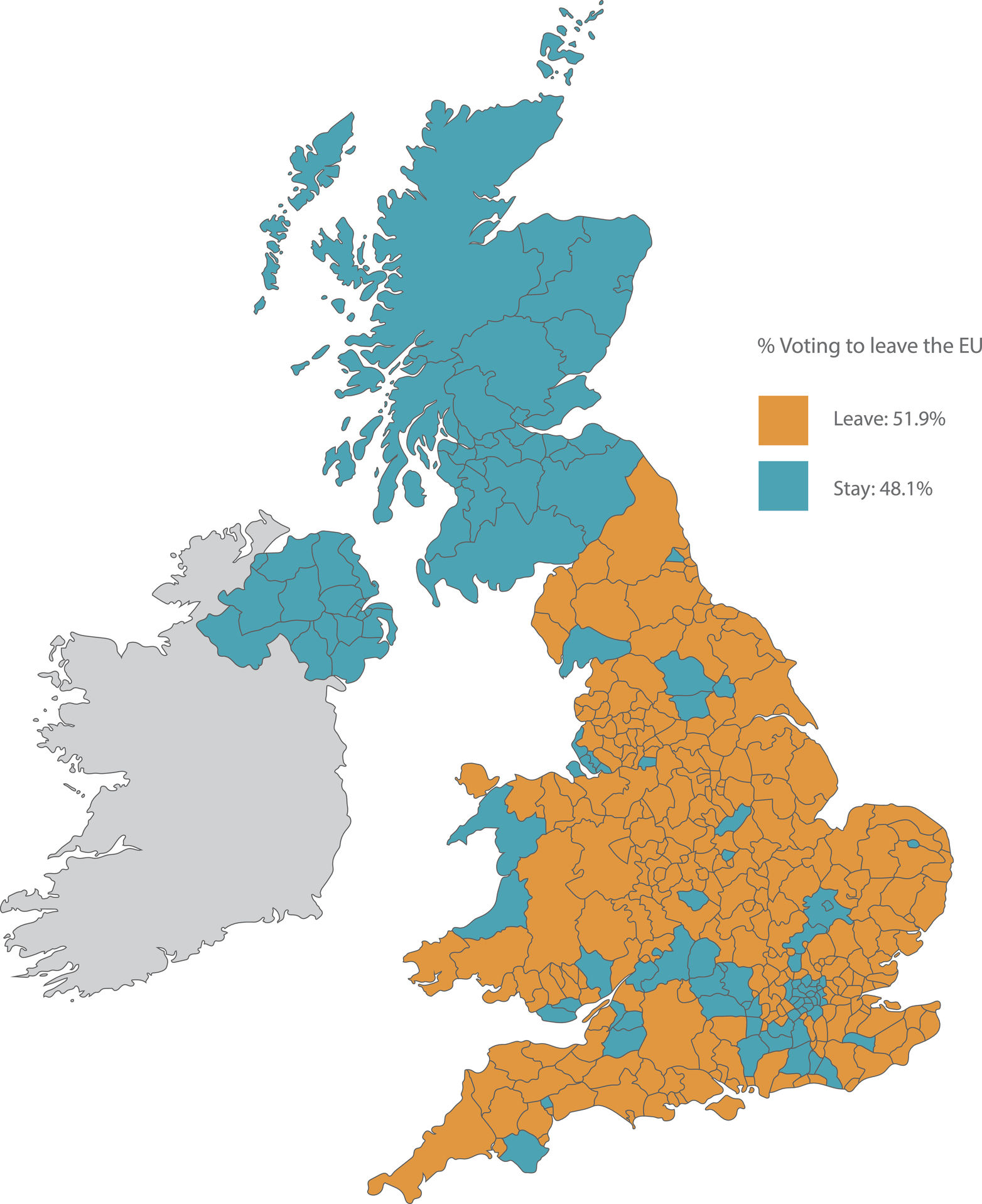
Elections and referenda don't come with a two-week, open-box return policy. Maybe they should. Because as the results of the European Union referendum (which was technically an advisory non-binding referendum for MPs to consider) emerged early on Friday morning, Leave voters across the UK realised that they had opened a Pandora's Box of negative consequences. And worst of all, they quickly learned that they'd been repeatedly misled to by the Leave campaign.
Within hours of winning the vote, Nigel Farage admitted that Leave advocates had "made a mistake" when they said £350 million a week would be redirected to the NHS. People had also been told that leaving the EU would put the UK in full control of immigration. Evan Davis found out on Newsnight that this too was untrue.


And there's more. The Leave campaign had advised concerned citizens not to listen to the ‘experts’ and ‘the scaremongers’ and that the economy would be just fine. And yet, in the first day of trading following the result, two trillion US dollars were wiped off the world’s share prices. UK markets lost more money in one day than the country paid into the EU over 15 years (most of which came back in grants, anyway). These losses affect everyone's pensions, jobs, salaries, and government income, and they will push Britain towards a recession that will make it even more difficult to deliver essential public services.
The pound dropped to a 31-year low, with serious impact on British imports and people's holiday travel abroad. And the UK suffered the ignominy of having its credit outlook lowered to ‘negative’ by ratings agency Moody's on the expectation that Brexit would deliver a serious blow to the UK economy.
In the political sphere, Scotland's First Minister Nicola Sturgeon has announced that a second Scottish independence referendum is highly likely, while Sinn Fein in Northern Ireland have called for a vote on Irish reunification. Some have even suggested for London to become an independent state so it can stay part of Europe (and possibly part of Scotland as well).
Meanwhile, the vast majority of young people, who voted overwhelmingly to remain, feel their own future has been taken out of their hands by an aging UK population that will not have to suffer the consequences of a lifetime out of Europe. As one woman said to me "up to yesterday I thought I had the choice of living and working in 28 European countries, now I'm restricted to one!"
The decision over the UK's future was based on false promises that pushed a minority of the UK's total voting population (17 million out of 46 million) to vote the way it did. Two years before Brexit will even become reality, according to EU rules, it is already having massive consequences on the UK economy, and on society. Brexit has fractured the country more than any other event in recent memory.
Based on the misrepresentation made by the Leave campaign, Parliament needs to take the petition of more than three million people to call for a new referendum seriously. The alternative is to watch a rapid decline of Britain's health and wellbeing.


When Nigel Farage was interviewed a few months ago he said that he would call for a second referendum if Remain won by a narrow margin. "In a 52-48 referendum this would be unfinished business by a long way," he stated. He went on to say that Remain needed to win by two thirds to end it and avoid a second referendum. Mr. Farage and the Leave campaign should now accept that the reverse scenario also warrants a second look.
The vast majority of MPs voted in by the electorate want the UK to stay part of Europe.  In light of the misrepresentations of the Leave campaign, Parliament should reject the results of this non-binding referendum as Nicola Sturgeon has announced she will do in Scotland’s Parliament. Before the UK government invokes Article 50 of the European Treaty and does irreversible damage to the United Kingdom, the people’s elected representatives must decide whether the facts that have emerged really warrant abandoning the EU and whether a second referendum will be needed.
If you agree that Parliament should take a second look at the EU referendum, please sign this petition.
Update:
It has been very interesting reading the extensive and varied feedback on the opinions I shared in this blog. What is coming through loud and clear is a great deal of passion from the British public and a desire for action. Great Britain and the world at large are going through a tumultuous time. The UK’s politicians – many of them with their own individual aspirations of power - need to behave in a statesmanlike manner more than ever. The Leave campaign accused the Remain campaign of scaremongering. The current situation illustrates clearly why they were not scaremongering, they were highlighting facts. The stock market and the pound are down and the world’s markets have continued to be hit. The business world hates uncertainty and without strong leadership, I worry that the UK’s economy will suffer long-term damage that is on the verge of going beyond repair. Bold, brave action is needed urgently.